Showing posts with label Bruce Springsteen. Show all posts

Thursday, April 01, 2010

Song of the Week: Bruce Springsteen "No Surrender"

In Monday's blog, I mentioned self-awareness in the songwriting process. I said that it can be a paralyzing thing for an artist, and a distancing thing for his audience.

What I meant is that many artists write with their audience in mind: "who will like this song, and who won't?" To a point, this is positive: their audience can keep them honest. Past a point, this is negative: they can write something worse, or less honest, because they're thinking of a faceless crowd rather than what might move any individual. The risk for the artist is "dumbing down" a song that doesn't need dumbing down, or (over time) creating a career of self-parody. Most good songwriters find the happy medium: they write better when they balance this self-awareness with artistic instinct. Some don't.

And all of this got me thinking about Bruce Springsteen.

I love most of Bruce Springsteen's music, and I admire his career as a songwriter. But Springsteen's most popular and celebrated songs are typically my least favorite, for the same reason I re-evaluated Born To Run some time ago: its bluster has always sounded contrived--and a little silly--to me. Maybe it's the album's production; maybe it's lyrics like "wrap your legs round these velvet rims/and strap your hands across my engines"; maybe it's the operatic warble--I'm not sure. Despite myself, I kept chuckling when I should've been cheering.

But my conflict wasn't that Bruce wrote jive like velvet-rim-strap-engines, or that his fans unabashedly love it. My conflict was that I couldn't hear the goofiness of those lyrics without considering the brilliance of "No Surrender," and wondering who the real Bruce is.

Song of the Week: "No Surrender"


It revisits familiar Springsteen territory: themes of love, youth, dreams, desperation, hope, with a vague anti-authority underpinning. It's also exactly the song that so many of his others want to be. It says--with each graceful, gorgeous, inspired couplet--what all of Born To Run writes around. No word is wasted, and no word is lazy. It's written in simple language, but is undeniably poetic. It packages a narrative, characterization, multiple themes, and gorgeous imagery, all in an accessible pop melody and a winning execution. It's proof that, when Springsteen wants to write a powerful, smart pop lyric, he's as good as anyone (something proven more with every passing album).

But "No Surrender," from Born In the USA, gets the full Boss studio treatment: a fist-pumping package, and an impersonal execution that belies the wonderful intimacy of the song itself. The Boss gave it that production because the he knew his audience would enjoy it. It would play well in an arena. His fans would expect and appreciate it.

Springsteen might be the major pop artist with the most clearly delineated dual voices: the guy writing for an audience (frequently well), and the guy writing for himself (frequently better). Unsurprisingly, Boss fans love all of it. But the Bruce songs I love most are the ones where he's making one person's story relate, rather than trying to write everybody's story. Unlike practically every other successful artist, Springsteen gets smarter when he's less self-aware.

To wit: "City of Ruins"


Or "Streets of Philadelphia"


Or "Blood Brothers"


And so many others. Bruce Springsteen: smart as he wants to be, and smart as we'll allow.

Think on, Boss. You'll rock anyway.

Jive turkey,
CM

Friday, May 08, 2009

Three Hour Tour

Back on that desert island, I've gots my Petty, and I've gots my Motown, and I ain't looking back. Here's my explanation:

First, the Springsteen vs. Petty debate. When people talk about Bruce Springsteen's importance, I don't fight it, and probably couldn't. He means a great deal to a great many people, and has probably shaped American singer/songwriter-dom as much as anyone post-Dylan. His particular brand of Jersey-tough-but-poet-at-heart became a successful artistic formula. He's made liberalism sound pragmatic. Maybe more than anyone, he's struck the right chord post-9/11. He's done nothing but churn out hit, after hit, after meaningful record, after meaningful record, for the better part of thirty years. I get it.

My issue with Bruce is that I hardly ever listen to him. Maybe it's the vocal histrionics, or the cringe-inducing grandpaerobics of his current shows, or maybe it's the pomp, grandeur, and full-throated circumstance of his best-known records...maybe it's just that I'm not from Jersey. It's not that I question his sincerity. I know he's sincere. It's that I can't relate to it. At all.

(Side note: I relate to sincerity. Just not whatever world he talks about and musical backdrop he uses to desribe it. Born to Run is the classic example, and one I've written about. I know, on paper, it's a good record. But I can't listen to it for purely subjective aesthetic hangups. It sounds cheesy to me. Incredibly cheesy. So cheesy I don't know how people listen to it and don't laugh. Again, maybe it's just that I'm not from the same place; like someone not from SoCal might not get past the sonic goofiness of the Beach Boys.)

So, save the odd latenight car-ride or road-trip celebration or any other incidental occasion, I don't seek out Bruce. "Blood Brothers" is the exception. I love that song whenever it finds me, and seek it out when it doesn't.

Tom Petty, for me, occupies the exact opposite end of the spectrum. It's an uphill battle to make the case that Petty's the more important figure (though I would make the case that he's a drastically underrated lyricist), he's one of the most listenable artists I know. In his entire catalog, there are maybe 4 songs I actively dislike. Everything else occupies some position between "casually enjoy it" to "fervently love it." His genius is not that everyone loves him; it's that nobody hates him.

And why should they? His songs are dynamic, melodic, inclusive, generous. He's grown and successfully experimented at every stage of his career. He knows his strengths, and trusts them enough not to pridefully chase his weaknesses. He says, simply, "I don't care what coffeehouse poet you think you are, ain't nothing on Picaresque that says more than 'Free Falling.'" And, of course, he's right.

So on my desert island, I need listenability. It's just me, and I don't need to find myself deep or important. I need someone who can bring any type of song to the table and take nothing off it. I want someone whose catalog is many and varied enough to keep me guessing and stave off boredom. I wouldn't last three days with Bruce and the Saxhounds. But Wildflowers alone could buy me a few years.

For the same reason (though by a much, much slimmer margin) Motown's catalog edges out Stax. This one was much more difficult for me to answer, because Stax's catalog is incredibly listenable in its own right, and obviously more indicative of where I'm from. Stax sounds like Memphis. Folks from there will always recognize its music as something not just wonderful, but inherently familiar. It sounds great, but it also sounds like home.

The issue, essentially, is that I'm an unabashed tramp for a great pop song. If you want to join the Motown-was-artistically-dishonest-shucking-and-jiving-for-white-folks-everywhere bandwagon, I won't stop you. I also don't care. There's no question that Stax, as a label representitive of an artistic movement (soul) and one committed to the representation of that art, sounds more vital, and in a way more authentic. But there's nothing dishonest about Motown's music. If you have a beef, take it up with the marketers. You can't tell me that the Four Tops didn't mean it when they sang. Motown produced some of the truest pop America's ever heard. Also--arguably--they produced the most beautiful songs.

It is a catalog so beautiful, so true, and so dynamic, that I don't think there's anything I'd rather take to the desert island. So, you can have the academic debates and talk to yourself about cultural importance-with-a-capital-i. What good is cultural importance alone, for eternity, on a desert island? To me, the beauty of the question that it takes social pretension completely out of the equation. It's you, and only you, on an island until you die. Nobody to lie to. Nobody to intellectualized art with. No conversations where you convince yourself of an opinion you don't actually share. On the island, there is no room for bs. All that matters is what you want to hear.

Sometimes, that's all that should matter.

This leads me to another question, to close out the week:

What is your favorite guilty pleasure?

This shouldn't imply that Tom Petty or Motown are guilty pleasures for me, or that they should be for anyone. They're great. I'm just taking the issue a step further. What would you enjoy most on a desert island, because you could listen, dance, and singalong without guilt? You're the only person around, forever. You can't be a dork.

So, to put it another way, what guilty pleasure would you most want to guiltlessly enjoy on the island?

Here's my Winner:


And Runner-Up:


Deal with THAT.

Highway in the night,
CM

Monday, April 20, 2009

I've Got Questions, You've Got Answers

First, a few housekeeping items. You'll notice a handsome widget on the sidebar--dashing, some might say--called "Show Schedule." This is where you can go to find about about future shows. And, hark! There are some!

This Thursday, April 23 I'll be playing in Little Rock. Details:
Chris Milam
Sticky Fingers, Little Rock AR
9:30
$4 at the door! Why? Because it's less than $5!

After that, you'll notice eight more shows listed. These are a series of YouTube Concerts I'll be playing throughout the next month or so. There are a ton of new songs and I wanted to play them for everyone--not just Nashville--as soon as possible! So all you have to do is hit up the Milam YouTube channel at noon on the day listed to find a new video...straight from me to you.

The YouTube Concert dates:
April 27
May 4
May 11
May 13
May 18
May 20
May 25
June 1

***I'd recommend subscribing to the YouTube channel, so you know the second a new video's posted!

Finally, check out the actual Milam Facebook Page (the musician page, not my personal one). It's updated on the regular, so hop on over and become a fan already! This is me, defining the relationship. Deal with it.

Okay, enough housekeeping...I've got a question for y'all. Chime in on the comments section and treat it like an open debate...I'm curious as to where everyone stands.

Here's the question:
Many of us are Bruce Springsteen fans. Many of us are Tom Petty fans. Some people love Bruce. Some people love Tom Petty. If you asked the average music fan which artist is "more important," they'd probably say Bruce. If you asked the average music fan which artist is hated less, they'd probably say Tom Petty (Bruce has a small and devoted and kind-of-weird group of vocal detractors; Petty's Petty because he's impossible to hate). They are two celebrated American singer/songwriters who have been successful for decades, and have a greater catalog that runs the gamut.

If you were going to spend the rest of your life on a desert island, by yourself, and could only bring the entire catalog of either Bruce Sprinsteen or Tom Petty, which would you choose?

Things to keep in mind:
--You are alone on this island for the rest of your life. There is nobody else around, nor will there ever be. You are free to dance or cry or celebrate in solitude however you want and nobody will ever know.
--You will have no other music on this island. It is either the Springsteen catalogue or the Petty catalogue for the rest of your life, nothing else.
--No right or wrong here...I'm just curious what y'all think.

So hit up the comments and start the revolution!

Can't hold out forever,
CM

Tuesday, January 09, 2007

Classics Under Fire: An Unoriginal Milam Series

...And we're back. While there's going to be plenty of new blog/site/Myspace content in the coming weeks, I thought I'd get us warmed up by posting something incredibly unpopular. Let's get to it.

Some time ago I was knee-deep in a Lester Bangs reader, elbow-deep in outrage, and chin-deep in bemusement: how could any self-proclaimed critic (which at least should imply a degree of familiarity if not expertise) take an unqualified sideswipe at Dylan's Blood on the Tracks, an album with an otherwise impeccable critical record? Simply put: Blood on the Tracks is the type of classic that no one dares to criticize. So Lester Bangs did.

What a tool, I thought. What a hack. He's the reason Dante reserved a special spot in hell for critics.

And then, a week ago, en route to Nashville for the six-hundredth time, I was listening to Born to Run and realized that no album is above criticism. Neither is any artist. Especially not The Boss.

In that spirit, I'm starting a new series that I'll infrequently revisit called, Classics Under Fire, in which a Young Artist of Relative Anonymity (played by me) takes a Universally Revered Work of Pop Music (Born to Run, in this installment) straight to task.

It should be first noted that I own Born to Run for a reason. I've always been a fan of the title song, along with "Thunder Road" and, on a good day, "Jungleland." I appreciate Bruce's Jersey grit. I appreciate his ambition, and the energy of his best work. And I of course appreciate the fact that, at the time this record was released, it meant a great deal to a great many people. So, it's something I own and in that sense I am one of its many fans.

But ho, ho, ho, is this album white. I don't mean that as a reference to the album cover, or as some sort of symbol for purity or innocence. I mean, quite simply, that this record exudes the type of potent cheesiness that can only come when a white guy takes ill-fated plunges into the depths of "soul" (not the genre, but the complete abstraction). It is the type of swaggering pseudosoul that only truly resonates with whitebread swaggering pseudosouls. Simply put, this record is the sound of your uncle calling something "Da Bomb." It is unavoidably hokey, from vocal pomposity of "World bustin' at its seams" section of "Night" to the melodramatic tenor of "Jungleland's" opening strings, to the nearly unbearable swing-jive-chicken dance of "Tenth Avenue Freeze-Out's" opening. Or, for that matter, the fact that one of the songs is actually titled "Tenth Avenue Freeze-Out." Way to talk that jive, Boss.

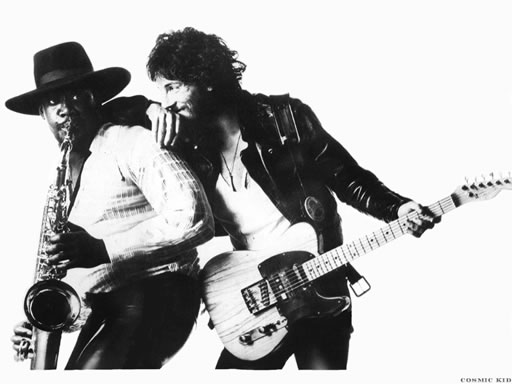
Look at him on the album's cover. Leaning pretty hard on that sax player, isn't he?

Throw in moments of true lyrical slop ("Cause this guy don't dance/and the word's been passed this is our last chance") and you have an album with cheesy production, a poor mix (Bruce's voice has been nearly neglected), overrated lyrics, and a fatal lack of self-awareness. These are the facts as they are (to this ear) hard to miss.

Now, I why do I own this record? Because some things have sentimental value. Born to Run does nothing but peddle sentimentality for 45 quasi-successful minutes, so its sentimental value is reasonably high. For that reason and that reason alone, I can enjoy it, even more so than 98% of the stuff out there. But this is a recipe for a time-tested guilty pleasure, not a classic album.

Which works a culture anoints its masterpieces say more about that culture than those masterpieces typically do. The fact that, 25-plus years later, Time magazine listed Born to Run as one of the Top 100 Albums of All-Time (sandwiched between Kind of Blue and Nevermind, no less) speaks more to our country's reverence for nostalgia than our ear for music. For example, Green Day's Dookie was the first album I bought by myself in a record store, and for that reason I'll always mentally teleport back to 6th grade whenever I hear "Basket Case." And for that reason, it might carry more emotional weight than, say, Radiohead's Amnesiac (which came out in the doldrums of my junior year in high school and which is, by nearly every account, a greater musical accomplishment than Dookie). Pop culture has a way of providing benchmarks to our lives. And, in the same way, Born to Run's legacy seems more that of autobiographical benchmark than artistic achievement.

I'd like to think that's one thing Mr. Bangs and I could agree on.